IT Vs Cyber Security, The Main Differences
In today’s digital-first world, the terms Information Technology (IT) and Cyber Security are often used interchangeably, but they represent two distinct yet interconnected domains. While both are critical to the functioning of modern organizations, their core objectives, responsibilities, and skill sets differ significantly. Understanding the difference between IT and Cyber Security is essential for businesses building resilient infrastructures as well as for professionals planning their careers in the tech industry.
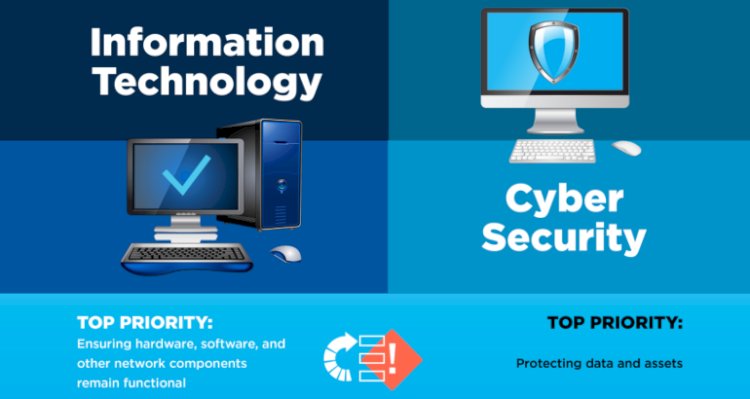
At its core, Information Technology (IT) refers to the broad field that deals with the use, management, and maintenance of technology systems within an organization. This includes hardware such as computers and servers, software applications, databases, and networks. IT professionals are responsible for ensuring that systems run smoothly, efficiently, and without interruption. Their work revolves around installing software, troubleshooting technical issues, managing networks, supporting users, and maintaining system performance. The primary goal of IT is to enable business operations by ensuring that technology infrastructure is reliable, accessible, and optimized for productivity.
On the other hand, Cyber Security is a specialized branch within the broader IT ecosystem that focuses specifically on protecting systems, networks, and data from cyber threats. While IT builds and maintains systems, Cyber Security defends them. Cyber Security professionals work to prevent unauthorized access, detect potential threats, and respond to security incidents. Their responsibilities include implementing firewalls, encryption, intrusion detection systems, vulnerability assessments, and risk management strategies. As cyber threats become more sophisticated, Cyber Security has evolved into a critical function that goes beyond just protection—it involves proactive monitoring, ethical hacking, and continuous improvement of defense mechanisms.
One of the main differences between IT and Cyber Security lies in their primary focus. IT is centered on functionality and efficiency, ensuring that systems work properly and support business needs. Cyber Security, however, is focused on protection and risk mitigation, ensuring that those systems are safe from attacks. For example, an IT team may set up a company’s network infrastructure, while the Cyber Security team ensures that the network is secure from breaches, malware, and unauthorized access. This difference highlights how both roles complement each other rather than compete.
Another key difference is the approach to problem-solving. IT professionals typically take a reactive and operational approach—fixing issues when systems fail or optimizing performance when needed. In contrast, Cyber Security professionals adopt a proactive and defensive mindset. They constantly anticipate potential threats, analyze vulnerabilities, and implement preventive measures before any attack occurs. This forward-thinking approach is crucial in today’s environment, where cyberattacks can cause significant financial and reputational damage.
The skills and tools required in each field also vary. IT professionals often work with system administration tools, cloud platforms, networking technologies, and software development frameworks. Cyber Security professionals, however, require expertise in areas such as cryptography, ethical hacking, threat intelligence, security frameworks, and compliance standards. Certifications also differ, with IT professionals pursuing credentials related to networking and system management, while Cyber Security experts focus on security-specific certifications and practices.
From a career perspective, IT offers a wide range of roles such as system administrator, network engineer, IT support specialist, and database administrator. Cyber Security, being more specialized, includes roles like security analyst, penetration tester, security engineer, and incident responder. While IT roles are foundational and widely available, Cyber Security roles are increasingly in demand due to the rising number of cyber threats globally, often offering higher salaries and faster career growth.
Despite their differences, IT and Cyber Security are deeply interconnected. A strong IT infrastructure is the foundation upon which effective Cyber Security is built. Without proper system management, even the most advanced security measures can fail. Similarly, without robust Cyber Security, IT systems remain vulnerable to attacks that can disrupt operations and compromise sensitive data. Organizations today are increasingly integrating both functions to create a unified strategy that balances performance with protection.
In conclusion, IT and Cyber Security serve different but complementary purposes within the technology landscape. IT focuses on building and maintaining systems that drive business operations, while Cyber Security ensures those systems remain protected from evolving threats. As digital transformation continues to accelerate, the collaboration between these two domains will become even more critical, making them both indispensable to the success and security of modern enterprises.